zondag 31 mei 2026

back to when

 seems that all that has been built up since the end of the war is unreavelling again and that we have to reconsider the WEU from the cold war era to keep things managable


yes the WEU

1954 to 2011


 (from wikipedia)

donderdag 21 augustus 2025

Furthermore


after the cadavre de ETO (and post-act submerging of painting)

A new lease perhaps – due to an anniversary issue of gold leaf, with certificates and open references as to what to do with it all, seemed appropriate, well perhaps even intentionally so (appropriation) for the european theatere of operations which has been rather dormant of late.

A chance to rekindle the personages involved, reminding us of the origins and references from bygone activities... and equally useful for the RNO as well as ACC...


the text accompanying the issue of shares reads thus:

“That set me thinking in a convoluted A to Band back to A way about (A) art, archives & anniversaires to (B) Big Blue, Bonn Ben Patterson's 'Rheingold' – blue chips an thence back to Klein's issuance of shares of air (A)...

this all in Chipping Norton no less, considering a display by the local contemporary showcase featureing Art & Language... The whole thing to be rendered as AAAA (Quadruple-A) ArtActionAéreAnniversaire … ombined with a definitive closure of the the site along the Rhine river at Bonn (Plittersdorf).


 see also report on triangulation drive september 2025.

zondag 16 februari 2025

theatre piece

 a bit like paper piece as related to me at the time of Ben P's visit in 2012 - this was also one with toilet and towelpaper, but by 'Unbeat' Yoshio nakajima during a lecture about his work at the anatomical theatre in the ghent academy - I include this im my series of 'European Theatres of Operation' due to the fact that this Japanese flux-fenomenon walked (hiked/hitched) all the way to Europe across Asia back in the sixties to become a major influence on the art of it's day - and remained... living in Sweden for ever so long...


donderdag 9 januari 2025

back on the street

 One of the first notions to pursue the ETO at all was a participation in street theate activities as a student - at the time politically engaged it was a format that seemed viable and pertinent... still is, but now on a very reduced, even 'unnoticed' scale - 

to wit

operation (Chien Brun Brussels)

this wrap-up of defuct archive material (from performances way back - remnants, slightly documentary but not really essential... in how far does an object (remnant) carry significance in the history of a piece... or add to the understanding of it?

a question still to be considered

vrijdag 10 mei 2024

street by street

 considering the re-delineation of streets as part of a european intervention (staring at Maubeuge in Nord Pas de Calais... completely redone after last war...)

here some trial runs


donderdag 30 november 2023

back and forth, less so

 whereas I used to zip back and forth to all sorts of venues constantly, it is now a matter of preparing and weighing the pro's and con's of any move, even the slightest... a different way of looking at it I suppose, and also perhaps a lot less energy lost.


considering the by-gones more than the 'what's to come' and making note of the passage - I remember watsching them load up the old giant wine barrels from the royal depot before it was demolished entirely, and marvelled at the craftmanship of the things - gone somewhere north to start a new life as a commercial decoration rather than a well-made public amenity - here an image when presumeably they were still if full use.

in my research I came across a mention which would tickle all supporters of the 'intercontinental entrepot' and also conjures memories of oneself having to go and file douane-papers and such in these hallowed halls:

to with the painter Vincent van Gogh himself to his brother Theo when he had just gotten to Antwerp:


zaterdag 26 november 2022


 On Time (lookback)

a déja-vu feeling arises when looking at the wanton destruction wreaked on U

a throwback to the forties of the last century...

woensdag 22 juni 2022

hi time (2 hit the road)

 high time for a new update on the current situation, being minimal... (do not see me theatre at its best)

- but also plans to move again (been a while with Covid and all that)


re-kindled the traditional 'triangulation drives' but decided to split into two parts

part one - south (second part in various guises, soon, see below)


we thought it good to rekindle this combination of research & visiting, and due to circumstances, opted for two separate trajectories – the first being south along routes we already know and have described elsewhere, with the exception of Heilbronn, which I never saw before – so every time there is something different to consider along the way... 


First leg south decided to do in two days – take some time at stations we usually just whizz past (fahn fahn fahn auf der autobahn) – taking the A4 direction Cologne and then the 61 south, which is still closed in parts due to the damage cause by the raging torrents last year – weather getting weirder every year – now to hot. Bonn and the requisite grave visitation, and then along the Rhine – past Coblence then, where the hills get steeper and rockier towards the Lorelei – which I have seen from the express train Frankfurt-Cologne many a time, but never stopped to have a good look – and perhps I waited too long, since the romantic shores are now festooned with white plastic camper vans – so much for that romantic vista which Victor Hugo once illustrated; backdrop to a wagnerian scene of the Rheingold or such – hard to envisage nowadays – but anyway heading south towards the 'Binger Loch' which always intrigued me – but here too not as impressed as I might have been a few years back... something lacking – need of a new choreography perhaps. Short stop at Bingen before heading further south and into the hills behind the wine-route at Neustadt... the Palatine forests... here too a sense of loss: many trees dead or dying, climate change and budworm, no looking good at all. 


We spent the night at the cloister Esthal, where we had been before, and which each time boasts less nuns to run the place, now being held together/barely afloat with some help from the east (polish?) but also in need of a new concept – not just yoga classes and mindfulness – but who still wants to work at it? Lovely old orchards and fields going to seed, crumbling forest and growing graveyard... but still a wonderful place to stay compared with alternatives in that price-range...


Meandering down the forest hills into the Rhine valley we had to adjust again to the frenzied speed-freaks hogging the Autobahn, just in time to get stuck in heavy traffic (well standstill in fact) at Karlsruhe. Where our old cafeteria on the river has been refurbished into a kitch-club and no longer an attractive pit-stop. Slow going, lots of roadworks gumming up our itinerary – deciding then to head straight for Munich rather than the Allgäu-route we had considered – backdrop scenery not really up to scratch anymore anyway... Munich on the other hand went well – used to be a major drama in various acts to get through – now a dark passage through new tunnels, but quicker – and so one might consider t-shirts with 'been to Munich, saw nothing' as novelty item...


Lucky for us the visit was at the foothills of the alps and therefore cool and green, as opposed to the burnt landscape we had left behind – so an idyll that still exists but for how long? 
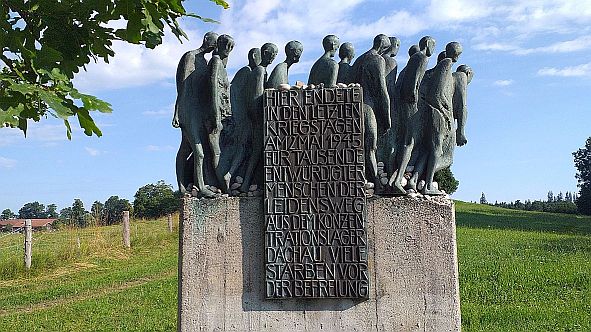
 

defaced memorial to death-march victims

 anti septic Prüm water (holy) dispenser

and jesussandals:


We decided on a zig-zag return route, avoiding the roadworks we by now knew well, and taking what turned out to be quite a scenic route west and then north and then west again, to then head back into the palatine hills and cross over to Belgium through the Ardennes stopping a Prüm just before the border... seemingly one of the most important cloisters in it's day, now sort of forgotten along the way. Founded in 721 by Bertrada the elder, a great-grandmother of Charlemagne, it had immense power and territories it it's day and under Pippin III acquired Christ's sandals from the holy land, still on view today – though scholars consider them to be merovignian house-shoes (pantouffles) and never saw the holy grail... anyway, it was an interesting unscheduled find an I must say I liked a thought over one of the doorways:

“God give all those that know me

still tenfold more

of what they treat me...” (1775)

On that note we headed into the Belgian Haute Fagnes...


and then a major new investigation into territory unknown - east


(more on that later too)


in the meantime a little ditty 


vrijdag 15 oktober 2021

askew view Chagall


Its been a while since I saw some Chagall works live in colour – having missed the recent exhibition of exiles in Paris (Chagall, Picasso, Mondrian) at the Stedelijke, in which they displayed a number of rarities from their collection – which is extensive and has some well-known favorites such as the Fiddler from 1912... All the more enjoyable then, the discovery of an 'underground' (literally) exhibition of Chagall at the Olaf Gulbranson museum in Tegernsee at the edge of the Bavarian Alps... A jewel of an exhibition based on a very pristine copy of the Lithographic suite 'Daphnis & Chloé' from 1961... His first major composite work in a medium which he would use extensively to ensure that everyone had access to his work, not only museums and the rich. 
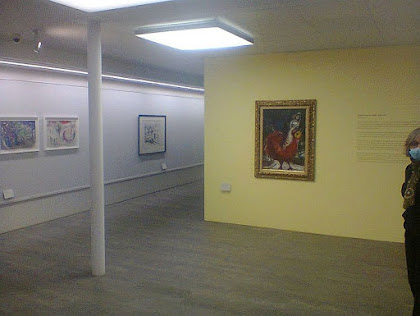


general view with nevers seen work


Already a treat to see the suite in it's entirety rather than just parts of it, this is but the beginning... Curator Michael Beck used his connections as partner in Beck & Eggeling (Düsseldorf) to convince a number of private owners to lend their Chagall's to the exhibition... which creates a added dimension which is in itself special, since many of these works have not been seen publicly for a long time or at all... A small but select group of intimate treasures, interspersing the lithographic series at intervals and connected to various periods and techniques, making the show a small but vigorous journey into the eventful life of the artist. In addition to theses 'discoveries' there is a small but extremely interesting note/sketchbook on display covering the period of his sojourn in Paris, flight and arrival in the United States, with the excruciating facets of the war, persecution of Jews, destruction of his hometown Vitebsk and the disaster of the refugee-ship 'Struma' as pictorial references to a series culminating in various crucifixions and the theodisic question 'How can God allow such horror?' The elaborate catalog features an article by Roland Doschka concerning this section.


Another section elaborated upon is the 'German' period of Chagall's life by Mario-Andreas von Lüttichau in which the strange and extreme metamorphosis from darling of Herwarth Walden's 'Sturm' and associates to the bane of the Nazi's who included Chagall's works in the infamous 'Entartete Kunst' exhibition – sketching the strange and incredible change of fortune in just a couple of decades with exact references and poignant moments (the sale of unwanted work for foreign currency in Switzerland). This is preceded by a more general view of Chagall's life by Bernhard Maaz, The Lithographic section is introduced by Andrea Knop, and as if this were not enough, the show and catalogue are accompanied by an extensive program of readings and presentations by specialists in their field as far afield as the Israel Museum in Jerusalem to put it all into context.


So, much more than just being able to enjoy Chagall's work in a small and intimate setting, it is an outside chance to view some very special works completely unknown but still familiar, including one wood-relief-collage one would expect Schwitters to make... but then he also turned to flowers in a later period... so too Chagall remains fresh and vibrant, familiar and surprising all at once in the small major exhibition... Well worth a trip if one is heading for the Alps... still until January 2022...


very good & complete catalog


Olaf Gulbranson Museum, Kurgarten 5, 83684 Tegernsee

info.ogm@pinakothek.de

www.olaf-gulbranson-museum.de


zondag 19 september 2021

finally

 Finally got to Paris again since a while, and finally the project that had been on the sheld since 1962 is being realized: the wrapping of the Arc de Triomphe - a sight for sore eyes... worth a trip.

broken Lantern and crane... 


zondag 7 maart 2021

euro-theatrix / cadavre


EuroTheatreCadavre


The current project at the Buktapaktop, being a “cadavre esquis” and sectioned in 8 or 9 parts due to the Covid-19 rules, makes for an interesting 'case' of theatre studies.. The exquisite corpse is of course not a physical one, but does have it's roots in the 'theatre of anatomy' - not only in terms of le Comte de Lautréamont's proto-dadaist statement of “the beauty of an encounter of an umbrella and a sewing machine on a operating table” but also in terms of dissecting thoughts in a “Tieranatomisches Theater” - name used in Berlin for ages..; and reminding us of our own mammalian condition – something we seem to forget often...

The fact that the former anatomical theatre now houses and operates the “Heimholz Zentrum für Kulturtechnik” (Centre for Cultural technology) seems very appropriate for my own considerations...


(TAT in the 1960's)


Beginning with the theatre of life & death as it were and the anatomical gaze as essential to understand the inner workings, even if missing the point constantly (dissected rabbit never to hop again)

(see also historical section)


so Buktapaktop's “Cadavere esquis” is something that I consider being performance, theatre and conceptual dissection at the same time – My first instalment was in fact in absentia: taking the day to investigate a stretch of coastline as a 'figure' representing anyone who had passed both recently and in history (as chance would have it these images were taken on one of the many bunkers left over from the “Atlantikwall' fortifications strewn all along the north sea coast - 

(picture taken by R. Pacquée)


here a report from the 'Obst' section


woensdag 6 mei 2020

Pencilpomegrenade beehive


Remains pencilled in / photoTrinks


Well I was pleasantly surprised when I had a look at the first results of my investigative project for the series "what remains" at defibrillator in Chicago... I had been somewhat dismayed at the technical problems we encountered ( aside from the sorry fact I couldn't be there myself) and had sort of reduced expectations... But no, it was quite interesting... The crew at DFBR8r had done a good job at installing the piece just in the passage between front and rear... So being part of the gallery space and at the same time the soul kitchen where artists congregate... The presentation being something in passing, an aside to the main events so to speak "en passant" as the french would say... Thus recreating quite well the memory of being out of class during lessons, so to say, sharpening pencils, as if that were an essential part of my education... And yes it was... 

Photo Trinks


Here too, the aside nature of the proposition, sharpening a pencil while passing by to get a drink or conversely, to see the next performance... And yet just as it is an aside, there is no pretension to a proposal... It seems to come when turning the handle of this manual machine that takes people back to when not everything was automatic. At the same time it's mechanistic and repetitive, grinding away at the troubles... Which is a very positive slant given by one of the participants...


C.R.'s wonderful befitting Beehive 
          ( Ph. Angeliki Chaido Tsoli)


The setup was perfect... Perfect too was the get-up that C.R. - the artist hosting my piece had prepared... A veritable school teacher from the early sixties... Decent but light & airy blouse with flower decoration, and a wonderful beehive sculpture of a hair-do, slightly flamboyant but retaining a certain strictness needed to keep the kids on the straight & narrow...  And yes, even though I had just mentioned this memory connected to the sharpener at school in passing... It is spot on: the beehive hairdo is also an original Chicago invention...  And what is more... It connects directly back to the pomegranate... By way of Vinci... The creator of the Beehive was Margaret Vinci Heldt, and earlier I had made reference to the grenades designed by Leonardo Da Vinci... But per chance came across a painting by him depicting mother and child ( mary & Jeeez...) with a pomegranate... Well well...


So much for synchronicity and serendipity...


So, after hatching the idea to replace the missing shavings-receptacle with a hollowed- out pomegranate, an idea that was also spawned by some fluke connection made to the projects preceding this one... The question of how many seeds, the varying traditions and meanings... Well, I actually counted the seeds in this one, and there are 468 of them, and as of yet I have not found a number that coincides in some mysterious way...

In the meantime I have had word that my copies of the four remain-investigations are en route... Looking forward to reading about all the other findings... And in the meantime, remains are being gathered everywhere... Virus r no virus...
Keep well!

zondag 8 maart 2020

PomGrenPenS


the next / second step to the pencil-shapening contribution to "what remains" as proposed at the end of the sharpening process to re-connect with the original performance.
full circle.

zaterdag 29 februari 2020

PencilPush(err)


everything that could / did go wrong (technically) and so this video is a sort of ersatz-perf-correspondence which will be expanded upon later...
Thanks for all those that did their best to make it possible...

zaterdag 1 februari 2020

February remainder series...

for the investigation at DFBRL8R gallery in Chicago I decided to go with an old sharpener - I was an inveterate sharpener as school, and wanted to know what happened to all those shavings...
see
https://dfbrl8r.org/event/remains-chapter-one


so,

Boston vs Chicago

Though Boston seems to be the slightly older brand, I have now come to realise that Chicago is well and truly in the running for pencil sharpening capital of the US of A… their Loomis & Shultz company being the home of the US pencil sharpening company, or American Pencil sharpening company… “US” being one of their early products) - APSCo… well, who would have guessed (except Chicagoans, who knew all along) — interesting industrial and social history there with the firs union lockouts and such… and…
for me the solution to a vexing question: why the boston sharpener didn’t have a see-through receptacle through chip/shaving receptacle… it’s not like they didn’t try… seems the patent war went back and forth and in the end Boston lost out… (having first won their plea… but I never came across a Boston sharpener with a window before…)

(see here a report on some labor dispute involving pistols and clubs… and two women roughly handled…)


But we get ahead of ourselves… though pencils are as old as the hills, pencil sharpeners only came into being with the advent of mechanically produced pencils, probably due to a uniformity that did not exist before… some sharpeners were produced on small local scales, but the first real pencil sharpener company was American.. in 1855 Walter Kittredge Foster of Bangor, Maine produced small hand-held sharpeners that were even sold in Europe as ‘the american pencil sharpener’…

APSCO (Automatic Pencil Sharpener Co.) became the largest after buying out the USpencil sharpener company in 1907, and together with other US companies dominated the market.


but the basic patent is from olcott, which was bought out by apsco…


but what i consider now as one of the more interesting aspects
of pushing pencils is from a belgian surrealist who did a lot of
work in Lapland, and as one might surmise: it all melted away

here a quick swipe at his snow pencil, as seen in a recent exhibit in Brussels...


Pencil Point
second part / consideration:


When doing some preliminary research I found this comment by Marilyn Rousseau as a response to a short history of Boston sharpeners on the net (related to the office museum I think)  - it quite endeared me:

Comments
For Christmas in 1948, I asked for a Boston pencil sharpener just like the one we had at school. It had eight holes for different sized pencils. Many years later, I wondered what happened to that pencil sharpener, and when I visited the old, abandoned farmhouse some years afterwards, I found it still screwed to a bookcase. The entire place had been stripped, even the kitchen sink was gone, but there stood my almost 70 year-old, rusted pencil sharpener. I unscrewed it, and brought it home where it resides in my sewing studio, and still sharpens pencils as good as new.
M.R.
August 22, 2017 1:03 pm
Also it reminded me that we too had a sharpener - though not a gleaming shiny one with multiple size-holes and all that: just a plain Bulldog, but which certainly did the trick and was with us for ever so long… I don’t know what happened to it but it’s no longer around… what did strike me though was that when I did a sketch concerning the absence of the shavings-receptacle I happened to automatically fill it in with red, which of course the Boston KS used in schools did not have a red shavings receptacle.

Memory is not always an efficient tool: what remains depends on all kinds of influences that may or may ot have anything to do with the reasoning behind it. Often I find myself believing something to be true based on first-hand knowledge only to find I’m amiss: and that memory has warped over the years to include hearsay, wishful thinking and just plain obstinacy.
Photographs and such are always helpful but not irrefutably conclusive, especially nowadays with electronic manipulation it is hard to state the neutrality of the image as once was taken for granted (even then, master-forgers could give even professionals the runaround) and thus we come to the subjectivity of the memory, the sub/conscious and the submerge-ability of suggestion, conjecture, speculation and belief…

(see also museum of the subconscious, B.P.)


I purposely did not enquire about the previous/original performance (it was given as option not to) even though I did see a heap of shavings as an additional proposition, I decided not to stay with only one remnant. - one that had spoken to me on a near-subconscious level rather than an intellectual - even though one might construe my recognition of what it was as an intellectual trait - albeit a cultural one: many non-americans from a certain (later) generation would not recognise it, just as I was surprised recently seeing someone who was not even that young not recognise a coffee mill… a hand cranked one admittedly… 

So when confronted at some stage during the correspondence with the mention of the name of the performer who had left this object behind I was in a quandary: look up the performance and carry on my considerations with the original intent and result in mind, or negate the information… (not delete, but set it aside for later…)  I chose the latter… otherwise I would have had to immediately put on my conservator’s hat and consider the best way to arrest, preserve and present the object at hand with the original intention and context as my guidance, as far as a definitive identification of these might have been possible.

(here too the aspect of the first section of this investigation comes to mid: to fix… not only in the sense of repairing possible damage, but to affix or to arrest context to the exclusivity of the original intention. I wanted to avoid that for the time being… If I had not, I would perhaps not have rememberd that my own sharpened was a Bulldog and not a KS… in this case the lack of information about a missing element has in fact conjured a new(old) memory tat might or might not have anything to do with it all.

to be investigated further…


part three

Referential…

I have been referring only to the subjective and supposed origins of my remnants, reflecting mainly on my own perspective, experience and attitude - while negating, yes actively negating information pertaining to the actual course of things that led to this remnant being included in the series… even though I have received information about the original performance, I decided to negate, or at least postpone any investigation or reference to it even though it is the main point of departure of any speculation. 
Instead I have been seduced by the meanderings of a non-specific research, a submersible one, that tends to flow and eddy like a stream, digress and turn in circles going no-where specifically in a hurry… from the beginnings of the modern pencil as a small part of the revolutionary ‘military industrial complex’ (to wit, alongside early flight as possible asset to military campaigns… Conté was known primarily as monglofier in his time…) digressing into the circumstances that led (lead…) pencil-producer Henry David Thoreau to retreat into the woods at Walden and be able to publish his findings through pencilmaking… though no-one seems to know if he actually used the pencils to write the book… mythology forms around these uncertainties, and any attempt to re-enact or trap a past performance is prone to hearsay (hear-see?) speculative interpretation… even the strictest empirical methodology has at some point to soften and allow a certain amount of conjecture: even if the intent of the original performer had been different that the actual version presented, it might not be opportune to divulge this information at that time, or any time for that mater, and thus become one of those variable of which I speak.

The rivalry between the American (Automatic) Pencil Sharpening Co. and Boston Pencil Sharpener, (still to this day: see recent article on “Sharpener Shootout: APSCO vs Ranger 55”) - not to mention the interesting social and labor histories involved… History of patent rights, (see A.B. Dick, also of Chicago) and the development of US capitalism and anti-trust laws in general… lots of digressions to get lost in I’m sure… and then there is gender politics too:

see ad from the  ///  vintage ads. live journal 


well well

(discussion: who came up with the first: “taille crayon” in 1828 pat 2444 Bernard Lassimone…Paris, then 1837 in the UK: similar “Styloxynon”…  (need to sharpen with knife before inserting) the again France: Thierry des Estwaux; thie first prism sharpener…  (NY bought some in 1853)

in the US Walter K Foster patented first sharpener in 1851… (waltee k fostee) 1855… and by 1860 was exporting to Europe for draughtsmen’s supplies… 

Revolution with A.B. Dick Planetary Pointer in 1896…  from then on various / improved versions etc..  see Love Sharpener (US pat #594114)

so much for the empirical dope…


 Okay, before the last entry (the one with the pomegranate seeds)

one might consider the loss of the shavings receptacle as the saving of the machine itself: becoming a curious remnant rather than just an old machine for… and getting tossed out. Often it is the most common piece of equipment that does not survive the test of time: too many of them around so everyone thinks… oh but there are so many around until there are… none around anymore…  
how then do we come from the stories of the great inventor Conté to the question of how many seeds… where do these investigations lead us,

how are we ever to make heads or tails of them if - as is the case here - the investigation itself produces more questions and material than the original thought ever considered?

zondag 1 december 2019

oh no?

then why not?

ProVilla, abandoned home of the provincial governor until fairly recently
they did away with provincial culture, and now everyone is looking for a new slant... question is... is there a new slant, or did we just jettison something we might well have needed in the future?

(thant's the new year question)

have a good one...

current & such review

here a quick look back
as well as current concerns
(see also ACC)


by chance found some pictures from some time ago too...
just a quick reference here...

 performing "Ehrung unsrer Sprache by Bernd Lohaus in 2010 with Marc Rosignol, Carlos Montalvo and Kate Mane.


fighting for the soul of capitalism
(and losing)
short action gallery MvBlerck, Antwerp September 2019


in october we did a

remake  (reprise) munich

(illuminated light version / analysis - more soon)


augmented with the members of Buktapaktop which could not participate live in Munich, so it was a quite different version, making the whole process more interesting and layered when one considers the other instances...


The original version took place in a theatrical cavern with all manner of technical assistance, making it more of a theatrical version, with the modification of mannerisms as a result that some found disturbing while others considered it an added bonus...


Buktagroup at Dads KloHäuschen, Munich, site of another intervention (with sones)

see & read more on dedicated blog:


an attempt to investigate the ramifications of the Actor-Network-Theory together with a group from Finland - at this point the jury is still out ... and probably will be for some time to come....


before that a solo attempt at the same venue...
precursor perhaps


much earlier (precursor)

also Munich


back to when

 seems that all that has been built up since the end of the war is unreavelling again and that we have to reconsider the WEU from the cold w...